
Hydroseeding & mulching
A nutrient-rich blend of seeds, mulch, binder and fertilisers, applied under pressure in a single layer. The technical solution for fast and even grass growth, even where conventional seeding falls short.
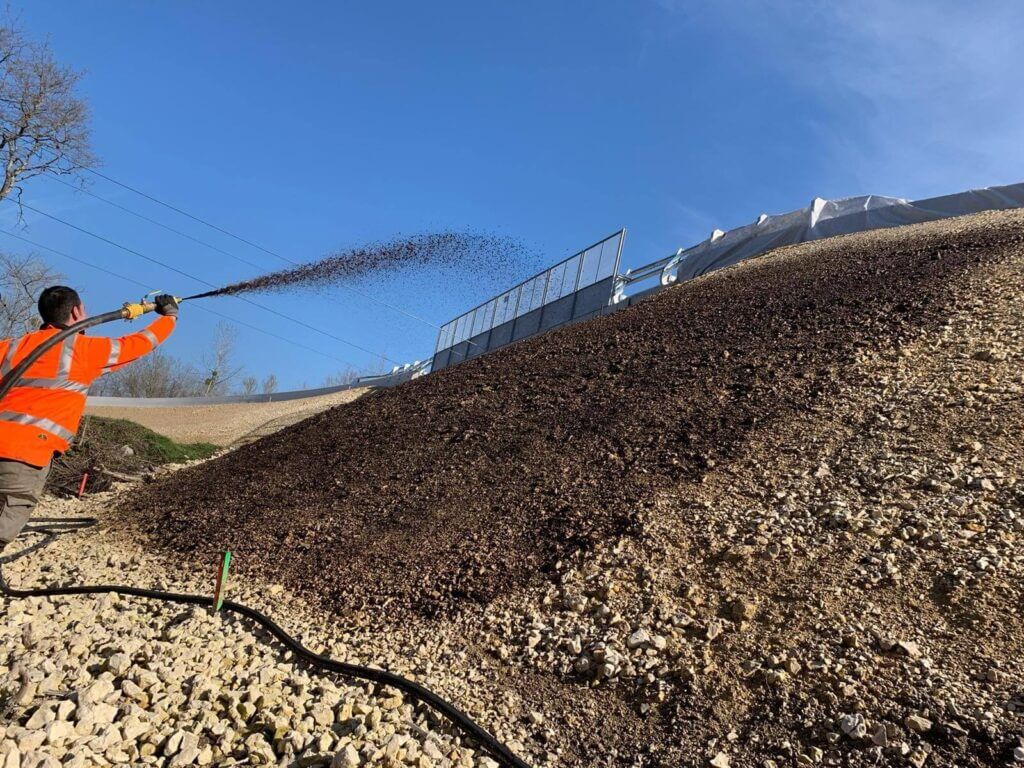
One layer,
multiple functions.
Hydroseeding combines water, seeds, mulch, fertilisers and a binder into one homogeneous mix. That mix is sprayed onto the soil under pressure and forms a protective layer in which the seeds can germinate ideally.
In hydromulching the focus is on the mulch layer: a thicker, fibre-rich cover that immediately protects the soil against erosion, drying out and seed wash-out. The result is an even, fast-developing turf, even on steep or hard-to-reach plots.
We always tailor the mix to the soil, the slope and the desired end result. That way every project gets the right composition of seeds and additives.
Why choose hydroseeding?
Fast, even germination
Seeds sit in a moist, nutrient-rich layer so they germinate faster and more evenly than with traditional seeding.
Erosion protection from day one
The mulch layer holds the soil in place and protects against wash-out from rain and blow-away from wind.
Suitable for steep slopes
Applied under pressure, the mix adheres to slopes, dykes and verges unreachable with other techniques.
Less weed growth
A dense mulch layer suppresses weeds and gives the sown grass a head start in the early growth phase.
Efficient on large surfaces
In a single pass large surfaces are treated. Ideal for construction sites, parks and infrastructure projects.
Durable result
A strong root structure and healthy turf contribute to lasting soil stabilisation.
- Steep slopes and dykes
- Construction sites and earthworks
- Verges and embankments along roads
- Parks and large-scale green zones
- Sports fields and recreational sites
- Recovery after erosion or soil disturbance
How a hydroseeding project runs
From first estimate to a closed turf: five clear steps.
Site survey and soil check
We assess surface area, slope, accessibility and soil structure, with a soil sample where needed.
Tailored seed mix
Grass species, fertiliser and mulch dosage are matched to soil, use and season.
Subsoil preparation
Loosening, levelling and debris removal create a proper seedbed and good mulch adhesion.
Application with the hydroseeder
The mix is sprayed under pressure in a single pass, up to several hectares per day.
Aftercare and inspection
You get an irrigation and mowing plan; we check germination and overseed locally if needed.
Hydroseeding, sowing or sod?
Three techniques, three situations. Here is how to choose.
| Technique | Visible result | Strength | Best for |
|---|---|---|---|
| Hydroseeding | Germination in 7-14 days | Fast, even and erosion-resistant on large areas | Slopes, verges, construction sites, hectares |
| Traditional sowing | Germination in 14-21 days | Low cost on small, flat ground | Small, level gardens |
| Sod | Instantly green | Immediately dense and walkable | Sites that must look finished at once |
What does hydroseeding cost?
The price per m² depends on surface area, slope, accessibility, soil preparation and the chosen seed and mulch mix. Larger areas are cheaper per m² because application happens in one pass. Send us the area, location and preferred timing and you get a free estimate within 24 hours.
Request a price indicationService area
Gazonic carries out hydroseeding and hydromulching throughout the Netherlands, Belgium and Germany.
- Hydroseeding typically germinates within 7 to 14 days with sufficient moisture, sun, and temperature.
- Suitable for slopes up to about 45 degrees without additional anchoring.
- One mixture contains water, grass seed, wood-fibre mulch, fertiliser and tackifier.
- Applied on areas from a few hundred m² up to several hectares per day.
- Immediately visible after spraying thanks to the brown or green mulch layer as a coverage check.
Frequently asked questions about hydroseeding
What exactly is hydroseeding?
Hydroseeding is the pressurised spraying of a mixture of water, grass seed, wood-fibre mulch, fertiliser and a tackifier. The mulch layer retains moisture and protects the seed, so it germinates more evenly than with traditional sowing.
How long does it take for the grass to appear?
With sufficient moisture, sun and temperature the grass usually emerges within 7 to 14 days. A fully closed turf normally follows after four to eight weeks, depending on season and soil.
What is the difference between hydroseeding and hydromulching?
Hydroseeding focuses on sowing, hydromulching on a thicker fibre layer that immediately protects the soil against erosion and drying out. In practice we combine both depending on slope and soil.
Does hydroseeding work on steep slopes?
Yes. The mixture bonds to the soil and can be applied on slopes up to about 45 degrees without additional anchoring. For steeper or heavier situations we combine it with erosion mats.
When can I walk on or mow the area?
Keep the area free of foot traffic as much as possible during the first weeks. The first mowing usually follows once the grass reaches 8 to 10 cm, typically four to six weeks after application.
What does hydroseeding cost?
The price depends on surface area, accessibility, slope and the required seed mixture. Send us the area, location and timing and you will receive an initial estimate within 24 hours.
In which period can hydroseeding be carried out?
From early spring to late autumn, as long as the soil is not frozen. Spring and autumn give the best germination thanks to higher soil moisture.
What does hydroseeding cost per m²?
The price per m² depends on surface area, slope, accessibility, soil preparation and the seed mix. Large, easily accessible sites cost less per m². You receive a free price indication within 24 hours.
Is hydroseeding better than sod?
It depends on your goal. Sod gives an instantly green, walkable surface; hydroseeding is more economical on large areas and slopes and produces deeper-rooting, site-adapted turf.
Do I need to water after hydroseeding?
Yes. The mulch layer retains moisture, but light, regular watering during the first two to three weeks is decisive for even germination, especially in dry or windy weather.
Do you also work in Belgium and Germany?
Yes. We work throughout the Netherlands, Belgium and Germany.
How large does a project need to be?
We work from a few hundred square metres up to projects of several hectares. On large areas hydroseeding is usually the most efficient method.
Ready for your project?
Share the surface area, location and desired timing. We'll get back to you within 24 hours with an initial estimate.